Heavy-Duty Storage Systems Catalogue
Engineered structural racking, push-back buffers, cantilever supports, and dynamic roll-formed systems tested under ANSI MH16.1 and ISO 9001 standards.
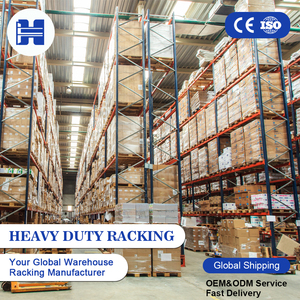
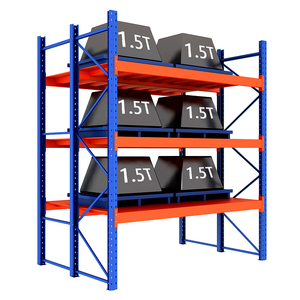
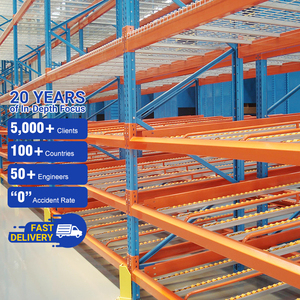
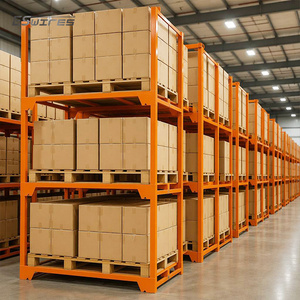
Enterprise Advantage & Manufacturing Engineering Excellence
Selecting premier top trusted pallet shelf rack suppliers and wholesalers requires looking beyond superficial structural metrics into metallurgical specifications, structural mechanics, dynamic shear calculation, and compliance frameworks. Modern industrial warehousing demands heavy-duty racking systems engineered specifically to handle localized seismic activity, intense high-bay forklift traffic, aggressive nearshoring turnarounds, and stringent safety standard audits like NOM-006-STPS and ANSI/RMI MH16.1.
As a specialized OEM/ODM industrial racking manufacturer and enterprise supplier, our production facilities utilize cold-formed high-tensile steel profiles (primarily Q235B, Q355B, and structural grade ASTM A1011). Utilizing continuous multi-stage roll-forming mills, automated robotic MIG/TIG welding cells, and eco-friendly electrostatic thermosetting epoxy powder coating lines, each racking upright frame and horizontal beam is fabricated to stringent tolerance margins ($\pm 0.5\text{ mm}$).
Custom footprint baseplates, expanded expansion wedge anchors, and heavy-duty diagonal frame bracing tailored to specific geographical seismic response acceleration parameters ($S_s$ and $S_1$).
All payload ratings undergo destructive finite element analysis (FEA) and real-world destructive testing to ensure beam deflection under maximum design loading never exceeds $L/180$.
Complete compliance documentation, load application plaques, structural design calculation packages, and safety inspection checklists supporting international regulatory standards.
Future Procurement Trends in Industrial Storage & Warehousing (2025–2030)
The industrial distribution sector is undergoing a profound structural shift driven by regional supply chain nearshoring, rapid e-commerce SKU proliferation, and the adoption of autonomous material handling equipment. Global procurement managers evaluating pallet shelf rack suppliers and wholesalers must consider four key technological trends shaping warehouse optimization:
Standard selective racking, while offering $100\%$ SKU accessibility, leaves up to $60\%$ of volumetric clear height underutilized due to wide forklift access aisles ($3.2\text{ m} - 3.8\text{ m}$). Modern procurement strategies heavily prioritize automated storage and retrieval systems (AS/RS), four-way shuttle pallet racking, and drive-in systems paired with multi-directional reach trucks. These systems compress aisle widths to as low as $1.8\text{ m}$, boosting pallet storage density by up to $85\%$ per square meter of industrial slab.
With global cold-chain logistics expanding for pharmaceuticals and perishable foodstuffs, racking hardware operates in ambient sub-zero conditions down to $-30^\circ\text{C}$. Standard powder paint coatings crack under thermal expansion and contraction cycles, leading to structural steel oxidation. Forward-thinking wholesalers now supply hot-dip galvanized (HDG) racking profiles (minimum coating thickness $65\text{ }\mu\text{m}$ to $80\text{ }\mu\text{m}$) or micro-porous thermosetting zinc-rich powder coats that resist moisture condensation and chemical corrosion.
Fast-growing third-party logistics (3PL) providers demand flexible racking architectures that adapt rapidly to varying inventory shapes. Boltless beam-to-column connectors with 75mm or 50mm pitch adjustment holes allow operations teams to adjust shelf heights without dynamic structural downtime or specialized hot-work permits.
Technical Comparison Matrix: Selecting the Optimal Rack Configuration
Understanding structural trade-offs between load capacity, selectivity, cost per pallet position, and forklift compatibility is critical when selecting pallet rack systems from wholesale suppliers.
| Racking Architecture | Target Load Profile | Storage Density | Selectivity | Handling Equipment | Typical ROI Horizon |
|---|---|---|---|---|---|
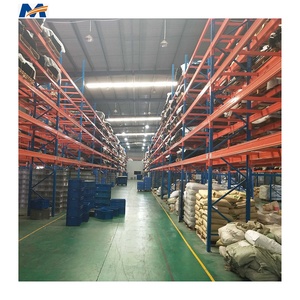
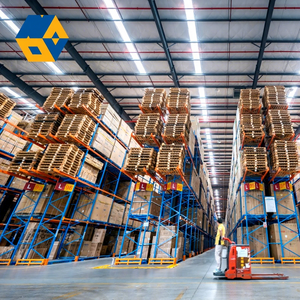
| Selective Pallet Rack | High SKU count, varied order profiles | Medium (40-50%) | 100% Direct Access | Standard Counterbalance / Reach Truck | Immediate (Low Initial Capex) |
| Drive-In / Drive-Through | Low SKU count, high pallet volume per SKU | Very High (75-85%) | Low (LIFO / FIFO) | Deep-Reach Forklift Truck | 12–18 Months (Cold Storage) |
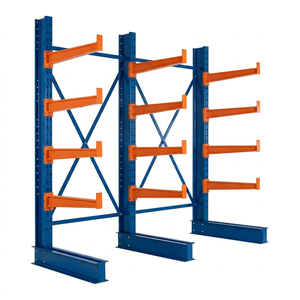
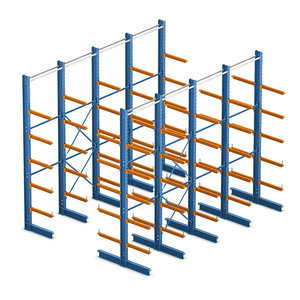
| Cantilever Rack System | Long, bulky, linear goods (tubing, timber) | Flexible / Open Front | High for linear profiles | Side Loader / Specialized Forklift | 18–24 Months |
| Gravity Flow Roller Rack | Perishable goods, strict FIFO inventory | High (70-80%) | Moderate per Lane | Standard Forklift (Loading/Unloading Bays) | 14–20 Months |
| Nestainer & Stacking Frames | Seasonal overflow, temporary staging | Modular / Dynamic | Batch-level Access | Standard Forklift / Pallet Jack | Immediate (No Floor Anchoring) |
Structural Mechanics & Safety Engineering Standards
To ensure long-term operational integrity and prevent catastrophic warehouse rack collapses, structural engineers calculate dynamic flexural strength, buckling modes of cold-formed open sections, upright frame axial loading, and beam connector shear capacities. Key structural elements every buyer must verify include:
Roll-formed upright posts engineered with multiple stiffening ribs along the web and flanges exhibit higher moment of inertia ($I_x, I_y$), resisting torsion and local buckling under heavy vertical loads.
Heavy-duty step beams or box beams feature 3-hook or 4-hook connector claws welded at end-plates. Automatic spring-loaded safety locks ensure beams cannot dislodge during forklift loading errors.
Industrial environments require heavy-gauge steel column protectors, row end guards, and wire decking to safeguard structural columns against fork-truck collisions and prevent loose cargo falls.
Frequently Asked Questions (B2B Procurement FAQ)
Need Custom Warehouse Layout Design & Wholesale Pricing?
Speak directly with our senior structural engineers to request CAD space planning, certified weight capacity calculations, and factory-direct volume quotes.
Contact Us