Heavy-Duty Storage Systems & Warehouse Racking Solutions
Explore our certified range of industrial racking systems, high-density push back assemblies, wire decking, and custom warehouse racking components engineered to international standards.
Engineering Principles of High-Density Push Back Racking
A technical whitepaper analysis on mechanical load dynamics, nested cart kinematics, gravity-assisted LIFO retrieval, and structural steel optimization for enterprise logistics hub operations.
Nested Cart Kinematics
Push back racking utilizes a series of nested, telescoping carts riding on inclined steel rails. When loading, standard forklifts push back the front pallet to reveal the inner cart underneath.
- 2 to 6 Pallet Deep Configurations
- Precision Sealed Bearings
- Zero-Tipping Cart Interlocks
Gravity Flow Dynamics
Rails are engineered with a precise 1.5% to 2.0% slope angle. Upon unloading, gravity automatically advances remaining pallets to the front picking face at a controlled acceleration speed.
- Controlled Deceleration Dampers
- LIFO Inventory Optimization
- Reduced Forklift Transit Distances
Structural Integrity & Deflection
Manufactured using cold-rolled high-tensile steel (Q235B / Q355B), beam profiles are optimized to adhere to maximum deflection limits under full design payload (L/180 standard).
- ANSI MH16.1 & FEM 10.2.02 Compliant
- Seismic Zone Anchoring Baseplates
- Impact Protection Column Guards
High-Density Storage System Architecture Comparison
Evaluating storage density, selectivity percentage, operational speed, and initial capital investment across leading industrial rack configurations.
| Racking System Type | Storage Density | SKU Selectivity | Operational Flow | Forklift Entry Requirement | Ideal Application |
|---|---|---|---|---|---|
| Push Back Racking | Very High (75%+) | Moderate (LIFO per lane) | Gravity Auto-Feed | Aisle Only (No Entry) | Medium SKU count, high-volume batch handling, cold storage. |
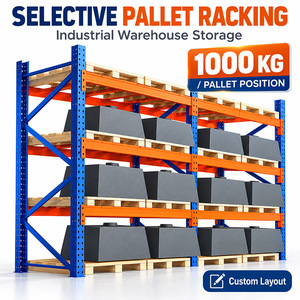
| Selective Pallet Rack | Standard (Baseline) | 100% Direct Access | Manual Pick/Place | Standard Aisle | High SKU variety, fast pick frequency, e-commerce distribution. |
| Drive-In Racking | Maximum (85%+) | Low (LIFO per block) | Manual Drive-Through | Enters Rack Matrix | Low SKU count, uniform palletized goods, seasonal storage. |
| Radio Shuttle Rack | Ultra High (90%+) | Flexible (FIFO / LIFO) | Semi-Automated Shuttle | Aisle Transfer Only | Automated cold hubs, massive volume distribution centers. |
Global Warehouse Procurement Trends (2025–2030)
Key technological shifts and macro-economic factors influencing warehouse design, factory supply chains, and material handling engineering worldwide.
1. Real Estate Optimization & Vertical Storage Growth
With industrial land acquisition costs rising globally by 14% year-over-year, logistics operators are prioritizing clear-height vertical expansion. Push back racking allows facilities to reclaim up to 50% lost floor space by eliminating intermediate aisles required by conventional selective setups.
2. Cold Storage Expansion & Energy Efficiency
Cold storage logistics require maximizing refrigerated cubic meters to reduce per-pallet cooling energy costs. Stainless steel push back carts equipped with cold-grade synthetic lubricants (-30°C operational certified) represent the preferred choice for frozen food wholesalers.
3. Integration with Autonomous Handling Systems (AGVs/AMRs)
Modern push back infrastructure is increasingly designed with precise mechanical guidance rails and laser-target reflectors, allowing seamless interfacing with Autonomous Guided Vehicles (AGVs) and automated reach trucks without human error risks.
4. Sustainable Green Steel & Low-Carbon Sourcing
Corporate ESG mandates require direct traceability of structural steel sourcing. Premier Chinese exporters provide certified low-emission recycled steel profiles alongside recycled epoxy powder coatings for eco-audited distribution centers.
Why Enterprise Logistics Partners Trust Our Export Capability
Combining state-of-the-art roll-forming automation, rigorous structural engineering, and end-to-end supply chain execution to deliver high-performance racking globally.
3D CAD & FEA Analysis
Every proposal includes full 2D layout drafts and 3D Finite Element Analysis (FEA) testing to verify load capacity and structural rigidity before steel cutting begins.
Certified Quality Control
ISO 9001 certified manufacturing facilities, mill test certificates for raw steel, weld ultrasonic testing, and automated powder coating thickness testing (60-80 microns).
Global Standard Compliance
Engineered to comply with ANSI MH16.1 (USA), FEM 10.2.02 (Europe), RMI standards, and local seismic regulations including CFE seismic design guidelines.
Bilingual Technical Support
Dedicated multilingual project management teams (English, Spanish, Chinese) supporting engineering RFQs, installation manuals, and post-sales maintenance.
Frequently Asked Questions by International Buyers
Technical and commercial answers for warehouse managers, procurement directors, and logistics engineers evaluating push back racking exports.
How does push back racking prevent cart jamming and derailment?
Our push back systems feature precision-machined heavy-duty steel wheels equipped with shielded stainless steel bearings running along custom structural rail profiles. Anti-lift tabs and interlocking cart flanges prevent derailment, even when forklifts push loads unevenly or during abrupt positioning.
What is the maximum weight load per pallet position for push back systems?
Standard heavy-duty push back systems support up to 1,500 kg (3,300 lbs) per pallet position. Custom reinforced cart structures can be engineered for specialized industrial applications carrying up to 2,000 kg per position, provided floor slab capacity ratings are validated.
Can push back racking accommodate varying pallet sizes within the same lane?
Yes. Custom cart nests can be designed with full-width steel deck plates or dual-width support bars. This allows facilities storing both standard GMA pallets (40" x 48"), Euro pallets (800mm x 1200mm), and non-standard industrial skids to operate safely within the same lane structure.
What lead time is required for container shipping from China factories?
Preliminary CAD design and structural load calculations require 3 to 5 business days. Production turnaround for standard 40ft container orders takes 20 to 25 days. Global ocean freight transit varies from 14 to 35 days depending on the destination port (North America, Europe, Latin America, or Middle East).
Are seismic calculations included for high-risk earth movement zones?
Yes. Every global racking system export is engineered according to the seismic acceleration coefficients of the specific site location. We provide heavy-duty enlarged seismic baseplates, anchor bolt specifications, and structural frame cross-bracing certified to withstand regional earthquake standards.
How does push back racking compare in maintenance costs to Radio Shuttle racks?
Push back racking is a 100% mechanical system with zero motors, batteries, or electronic sensors. This results in significantly lower long-term maintenance costs and zero downtime caused by battery degradation, electrical failures, or software glitches common in automated shuttle systems.
Optimize Your Warehouse Footprint Today
Send us your warehouse floorplan dimensions, clear height, and pallet specifications. Our senior structural logistics engineers will return a complete layout design and factory-direct quotation within 72 hours.
Inquire Now